
Active Warrants in Forsyth County
Warrants in Forsyth County are issued by the courts. A magistrate or judge signs an arrest warrant when there is probable cause that a person committed an offense. Other warrants come from a judge after a missed court date or a violation. The Forsyth County Sheriff's Office, led by Sheriff Bobby F. Kimbrough, Jr., serves these warrants and runs the public Police-to-Citizen (P2C) system where wanted persons may be listed. The court signs the order. The sheriff acts on it.
Warrants reach the public catalog only when the sheriff chooses to publish them. The Wanted Persons and Most Wanted catalogs are updated by the agency, but there is no fixed public refresh schedule for every entry. A newly signed warrant may take time to appear, and many never appear at all. Because of this, an empty search result does not prove that no warrant exists.
An arrest warrant and an order for arrest are the most common types tied to wanted listings. An arrest warrant names a person and an offense. An order for arrest often follows a missed court date or a violation in an open case. The court signs both. The sheriff then serves them and may add a public entry. A bond may be set on the warrant itself, which controls how a person can be released after arrest.
Always confirm warrant status through official offices, not a third-party site.
Types of Warrants in Forsyth County
Warrants come in several forms, and each one starts for a different reason. Some follow a fresh criminal charge. Some follow a problem inside an open case, like a missed court date. A few are tied to other states or to civil orders such as child support. Knowing the type helps you understand what the order means and how to resolve it.
- Arrest warrant - issued after a magistrate or judge finds probable cause for an offense.
- Bench warrant / order for arrest - often triggered by a failure to appear or a violation of a court order.
- Search warrant - authorizes a search of a place or property and may be sealed while active.
- Fugitive / extradition warrant - tied to a charge or hold from another jurisdiction.
- Civil order / child support enforcement - may lead to arrest or a contempt process depending on the order.
How to Search Forsyth County Warrants
The sheriff's P2C system is the main public tool. It carries a Wanted Persons catalog and a Most Wanted catalog. Both work like the jail roster catalog, with a free-text search box and an advanced filter dialog. A view of the Wanted Persons catalog shows the public search layout, from the Forsyth Sheriff Wanted Persons catalog.
The catalog above is the first public stop for checking a name against published wanted entries.
- Open the Wanted Persons catalog or the Most Wanted catalog.
- Type a name in the search field, or click Advanced to filter by field, operator, and value.
- Click "See More Detail" on a listing to expand the charge and agency data where shown.
The Most Wanted list highlights priority cases and is more likely to include a photo. A capture of that catalog shows how priority listings appear, from the Forsyth Sheriff Most Wanted catalog.
If the person has already been booked, their charge may instead show on the jail roster rather than a wanted list.
Forsyth County Warrant Search Fields
The Wanted Persons and Most Wanted catalogs use the same Police-to-Citizen search pattern as the inmate roster. A simple free-text box runs most searches. An Advanced button opens a filter dialog with a field, operator, and value, plus match logic and sort options. None of the fields are strictly required to run a basic search.
| Field Label | Type | Required | Notes / Format |
|---|---|---|---|
| Search | Text | No | Free-text catalog search; same P2C pattern as the inmate catalog. |
| Advanced | Button | No | Opens the advanced filter dialog when available. |
| Field | Dropdown | No | Selects the P2C advanced filter field. |
| Operator | Dropdown | No | Equals and other operators may be available. |
| Value | Text | Yes to add filter | Used with the selected field and operator. |
| Results meet all / any filters | Radio | No | Match all filters or match any filter. |
| Sort by | Dropdown | No | Sort options vary by catalog. |
| Search / Cancel / Clear | Buttons | No | Execute or reset the search. |
What a Forsyth County Warrant Record Shows
A public wanted listing does not show everything in the underlying court order. The catalog displays what the sheriff chooses to publish. Most entries carry a name and a reason. Some add a photo and physical details. The amount of data varies from one listing to the next, and a "See More Detail" button may expand a public record where the agency allows it.
| Field | What It Shows |
|---|---|
| Name | The wanted person's name as published by the sheriff. |
| Physical descriptors | Age, gender, and race if included in the listing. |
| Photo | A photo when a most-wanted profile includes one. |
| Charge or warrant reason | The offense or reason behind the warrant. |
| Agency | The agency tied to the wanted listing. |
| Last known location | A last known address or area if published. |
Note: A public wanted listing is a sheriff notice, not the official court warrant, so the full order and bond terms should be confirmed with the court.
What to Do If You Have an Outstanding Warrant
An outstanding warrant does not go away on its own. Ignoring it usually makes things worse and can add new charges. The safer path is to learn the warrant's status, get advice, and resolve it in an orderly way. Do not rely only on a third-party site, since those listings are often wrong or out of date.
- Search the official Wanted Persons catalog and the eCourts portal to check case status.
- Call an attorney or the Public Defender's office if you have an active case.
- Contact the clerk, magistrate, or sheriff through official numbers to confirm next steps.
- Arrange a safe surrender or court appearance, and bring ID and any bond paperwork.
- After resolution, confirm the case status in eCourts and check that the sheriff system updates.
Important: Talk to a lawyer before you turn yourself in, because counsel can often arrange bond and a court date in a way that protects your rights.
Help is available even if you cannot afford a private attorney. People who qualify may get a court-appointed lawyer through Indigent Defense Services. The Forsyth Public Defender is Paul James, who leads Defender District 31. The District Attorney for Prosecutorial District 31 is Jim O'Neill, and that office prosecutes the criminal cases behind many warrants. Knowing who is on each side helps you plan a surrender or a first appearance with less stress.
Related Sheriff and State Tools
The sheriff's site links several public tools beyond the wanted lists. A Daily Bulletin posts agency activity, which can give context around arrests and releases. It is not a court record, but it can help you track recent events. A capture of the bulletin shows the kind of activity the sheriff publishes, from the Forsyth Sheriff Daily Bulletin.
The bulletin can flag activity, but warrant status itself should still be confirmed with the court or sheriff.
The state keeps a separate registry for a different purpose. The North Carolina Sex Offender Registry, run by the NCSBI, lists registered offenders and is not a warrant tool. A view of the NCSBI registry information page explains what it covers, from the NCSBI sex offender registry page.
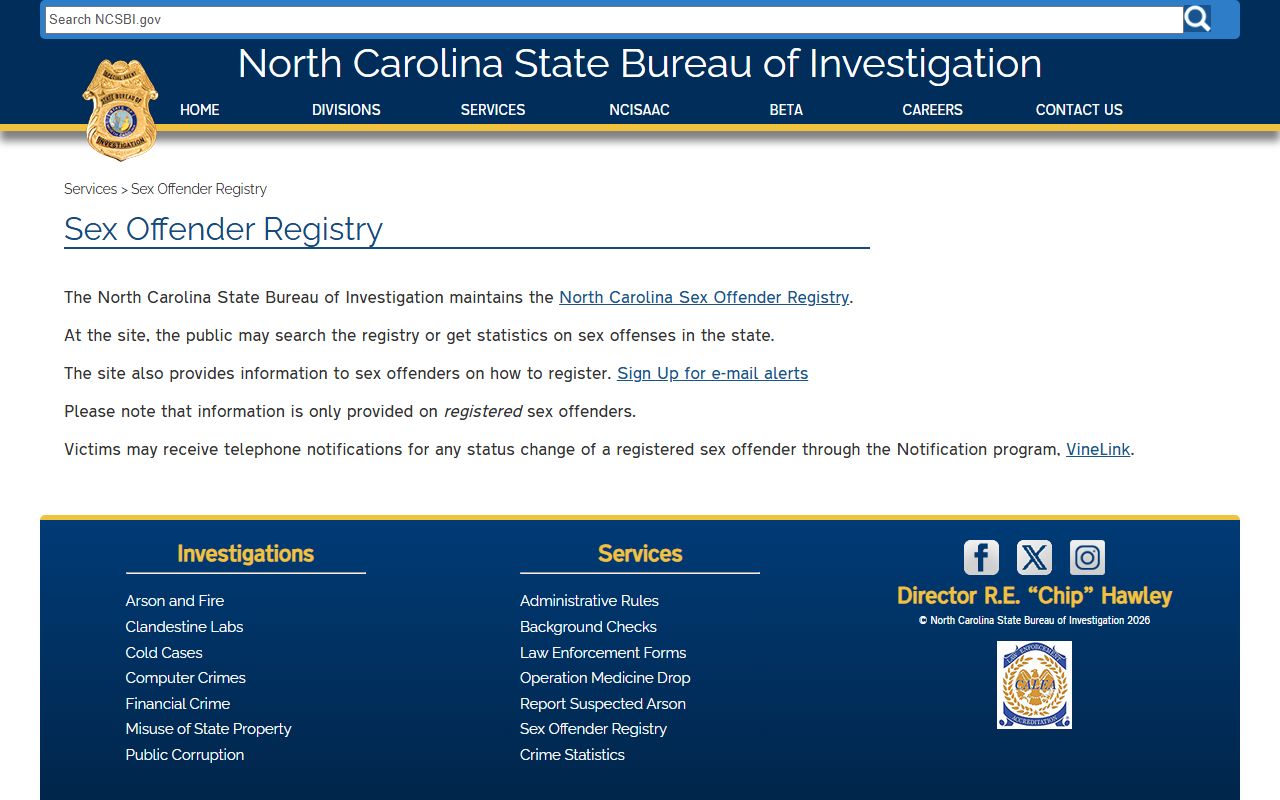
The registry covers registered sex offenders only, so do not confuse it with the wanted catalogs.
Restricted Forsyth County Warrant Records
Not all warrants are public online. The presence of a Wanted Persons catalog does not mean every active warrant is listed. Several types are commonly held back. Sealed warrants stay out of view while active. Search warrants may be sealed during an investigation. Juvenile warrants, sealed indictments, out-of-county warrants, and newly issued warrants may not appear in the public lists either.
This is why a blank search result is not proof. The only sure way to confirm a warrant is through official channels, such as the clerk, the magistrate, or the sheriff. For charges that follow an arrest, see Forsyth County arrest records. Federal warrants are handled by federal agencies and will not show on the county sheriff catalog.
The court file gives a fuller picture once a case opens. After a warrant is served and charges are filed, the case can be searched in the statewide North Carolina eCourts Portal. The portal shows case events, court dates, and dispositions, while the sheriff catalog shows the wanted status. Reading both together is the most reliable way to track a warrant from issue to resolution.