
How to Search Forsyth County Court Records
Forsyth County court records are searched through the statewide North Carolina eCourts Portal, not a county-built case system. The portal landing page offers four public tools: Smart Search, Search Hearings, Make Payments, and NC Judgment Search. Smart Search is the main case-record tool. It returns a near real-time Case Summary, also called the Register of Actions, with party information, case events, dispositions, hearings, and financial entries when they apply. The county Judicial Branch page links to the portal under "Find a court date."
You need a little prep before you start. Have the exact case number if you know it. If not, gather the full party name, a business name, an attorney name, or a citation number. The portal asks anonymous users to clear a CAPTCHA check, and Tyler reissues that challenge every five minutes. Treat what you see as a public docket summary, not the official record.
- Open the Forsyth County Judicial Branch page or go straight to the eCourts Portal.
- Pick Smart Search for case records, or Search Hearings when you only need a court date.
- Search by record number if you have it, or by party name, business name, attorney name, attorney bar number, citation number, cross-reference, or nickname.
- Open Advanced Filtering Options to narrow by Forsyth County, case type, case status, filing date range, and date of birth.
- Review the docket entries, then request a certified copy from the Clerk of Superior Court if you need an official document.
The North Carolina eCourts rollout finished in all 100 counties on October 13, 2025, so Forsyth case data now lives in the same Odyssey system used statewide. A screenshot of the official eCourts overview shows how the program is described.
A look at the statewide eCourts overview helps set expectations for what the public portal can and cannot do, drawn from the North Carolina eCourts page.
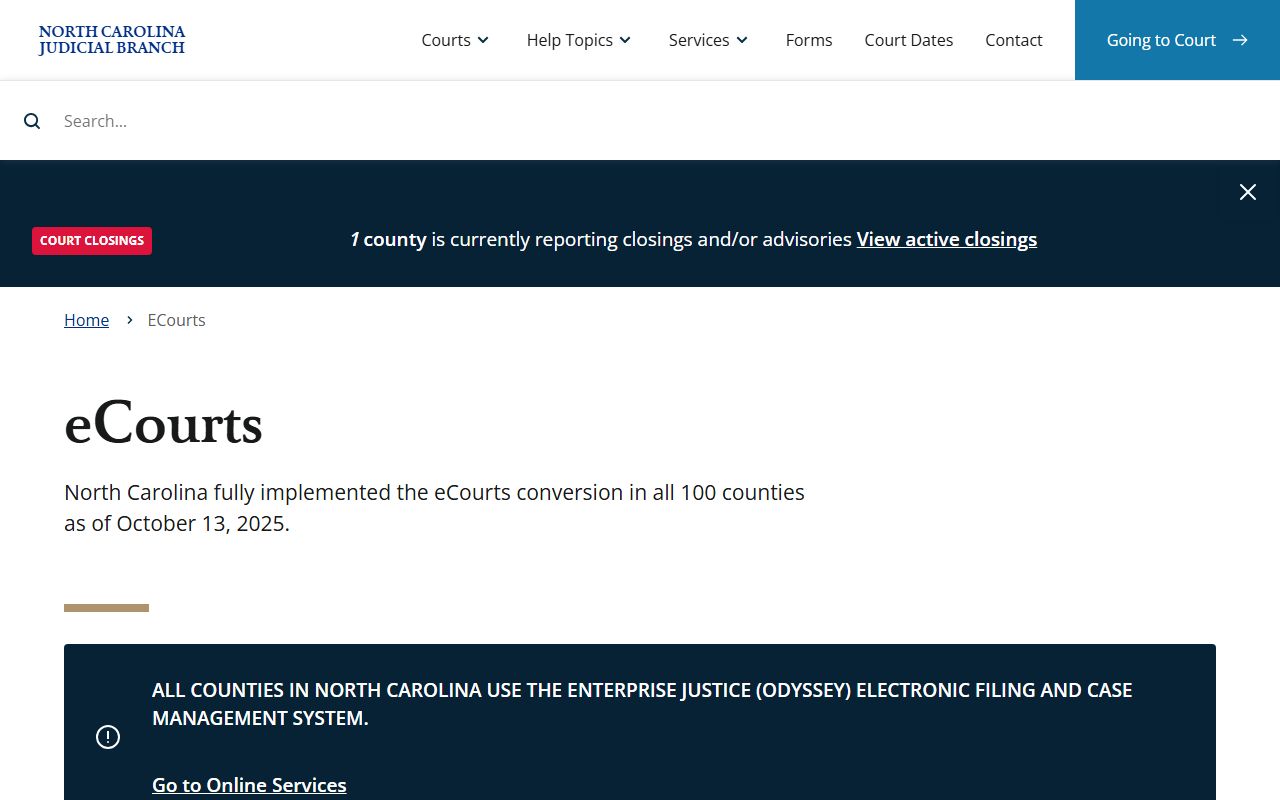
The portal is the front door for Forsyth County court records, but it is paired with the clerk for anything official. Older paper files and sealed matters may never appear online.
The Forsyth County Judicial System
North Carolina has no separate local court systems. The Forsyth County Court is a local session of the statewide General Court of Justice. That system has three parts: the Appellate Division, the Superior Court Division, and the District Court Division. Forsyth County falls in Superior Court District 31 and District Court District 31. Superior Court is the higher trial division. It hears felony cases, larger civil disputes, appeals from District Court for trial de novo, and special proceedings. District Court handles misdemeanors, infractions, traffic, family law, domestic violence, juvenile matters, and small claims.
The Clerk of Superior Court is elected in each county and keeps the records. Superior Court judges rotate among districts. Small claims sit inside District Court and are heard by magistrates without a jury. This screenshot of the official Superior Court overview explains the higher division's role, from the North Carolina Superior Court page.
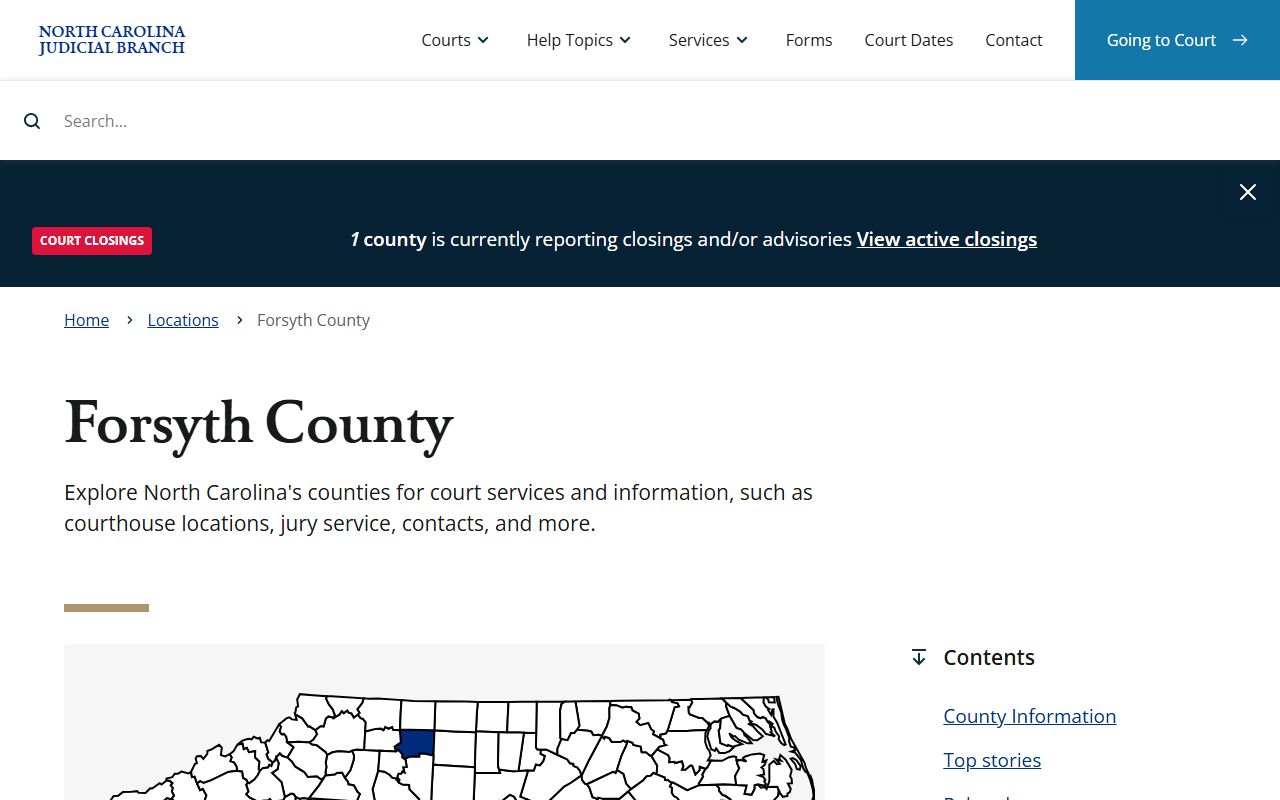
The county landing page above ties together districts, courthouse links, court dates, forms, and related programs for Forsyth County users.
Case flow: District Court › Superior Court › North Carolina Court of Appeals › Supreme Court of North Carolina
| Court | Jurisdiction | Case Types |
|---|---|---|
| District Court (District 31) | Lower trial division | Misdemeanors, infractions, traffic, family, juvenile, domestic violence, small claims |
| Superior Court (District 31) | Higher trial division | Felonies, larger civil cases, special proceedings, District Court appeals |
| Court of Appeals | Intermediate appellate | Appeals from the trial divisions |
| Supreme Court of North Carolina | Highest state court | Final state appeals |
Forsyth County Courthouse and Offices
The current state courthouse is the new Forsyth County Courthouse at 175 N. Chestnut Street in downtown Winston-Salem. It is the hub for the Clerk of Superior Court, Superior and District Court judges, the District Attorney, magistrates, juvenile court, and clerk divisions for civil, criminal, estates, foreclosure, guardianship, and more. The county jail and Register of Deeds sit close by on the same downtown court corridor. A view of the official courthouse page shows the building and its public hours, from the Forsyth County Courthouse page.
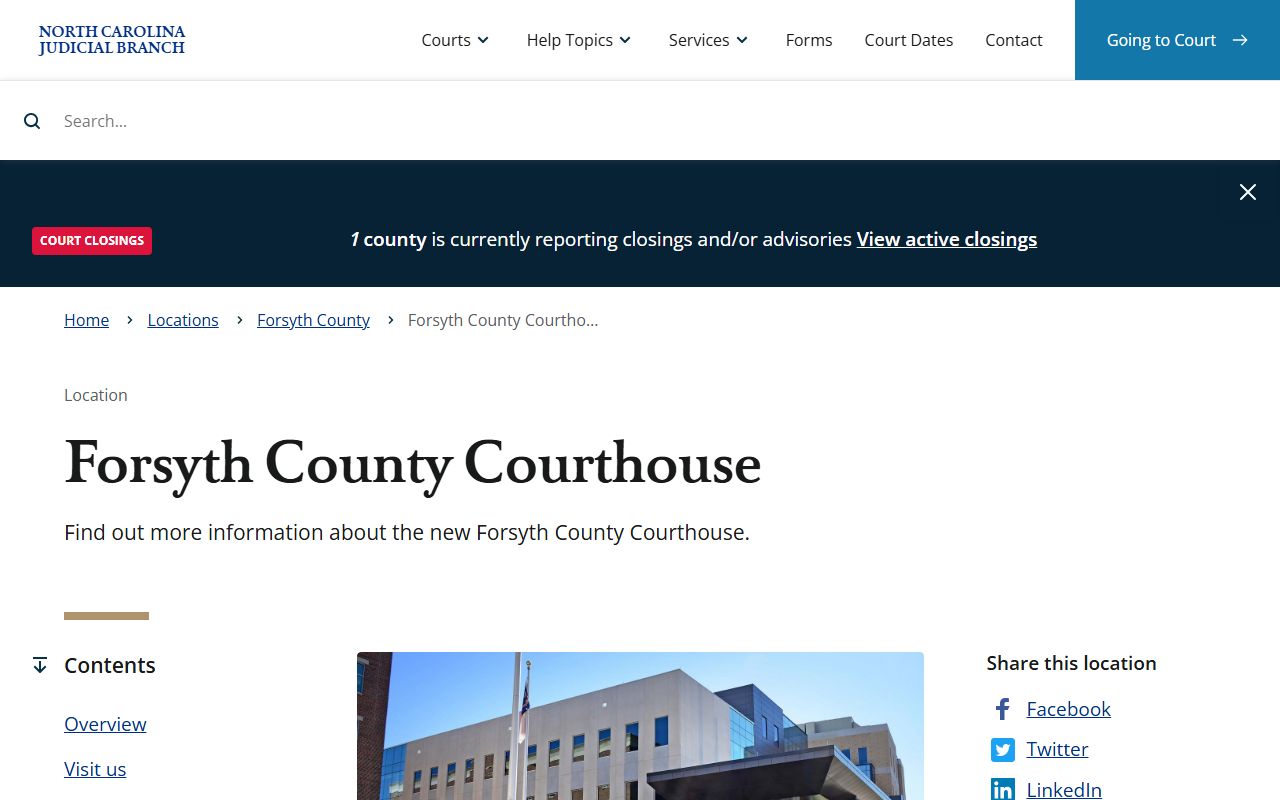
The three offices below cover most Forsyth County record needs. The clerk keeps court files, the Register of Deeds keeps marriage and land records, and the sheriff runs the jail.
Forsyth County Courthouse
175 N. Chestnut Street
Winston-Salem, NC 27101
(336) 779-6300
Register of Deeds
201 North Chestnut Street
Winston-Salem, NC 27101
(336) 703-2700
Law Enforcement Detention Center
201 North Church Street
Winston-Salem, NC 27101
(336) 917-7600
Types of Court Records Available in Forsyth County
The Forsyth County Court produces many record types. Civil files hold complaints, motions, orders, and judgments. Criminal files hold warrants, citations, indictments, bonds, plea documents, and sentencing. Family files cover divorce, custody, child support, and protective orders. Estate and probate files are kept by the clerk through the estates division. Traffic and infraction cases run through District Court.
Which court produces a record depends on the case. Felonies and larger civil suits sit in Superior Court. Misdemeanors, traffic, family, and small claims sit in District Court. Some records are public, and some are sealed by statute.
- Criminal records - warrants, charges, pleas, dispositions, and sentences from both trial divisions.
- Civil records - lawsuits, judgments, liens, and small claims heard by magistrates.
- Family and divorce records - absolute divorce, custody, and support filings kept by the clerk.
- Probate records - wills, estate inventories, and letters issued through the estates division.
- Traffic records - citations, court dates, fines, and dispositions in District Court.
What Forsyth County Court Records Show
A public case record in eCourts can show a lot. The Register of Actions lists filings, hearings, orders, and dispositions in date order. You may see the case caption, the case type, the court location, and the assigned judge. Financial entries show fines, fees, costs, and bond information when they apply. Documents themselves may or may not be visible, since access depends on case type and confidentiality rules.
Some details never show in public view. Social Security numbers, financial account numbers, and protected minor information are redacted. Sealed, expunged, juvenile, and adoption matters do not appear at all.
| Field | What It Shows |
|---|---|
| Case Number | The exact file number and the best search key for a case |
| Filing Date | The date the case opened or the charge was filed |
| Parties | Plaintiff, defendant, petitioner, respondent, or estate name with attorney links |
| Charges / Cause | The criminal charge and statute, or the civil cause of action |
| Disposition | Dismissed, disposed by plea, judgment entered, conviction, or not guilty |
| Sentence / Judgment | The final outcome, including penalties, awards, or obligations |
Public Access Laws for Forsyth County Court Records
North Carolina has both a general Public Records Act in Chapter 132 and court-specific record statutes. The key court statute is G.S. 7A-109, which directs clerks to keep records and, except as prohibited by law, makes them open during regular office hours. For Forsyth County, that means the Clerk of Superior Court is the official keeper, while the eCourts Portal is just an access tool. Confidentiality statutes override the general rule for juvenile, adoption, mental health, expunged, and sealed records.
Key Statutes:
N.C. Gen. Stat. § 7A-109 - Clerks must keep court records and, except as barred by law, keep them open during office hours.
N.C. Gen. Stat. § 132-1 - Defines public records broadly for state and local agencies in North Carolina.
N.C. Gen. Stat. § 132-6 - Requires custodians to allow inspection and copies at reasonable times.
A capture of the court records help topic shows how the Judicial Branch frames record access and background checks, from the court records help page.
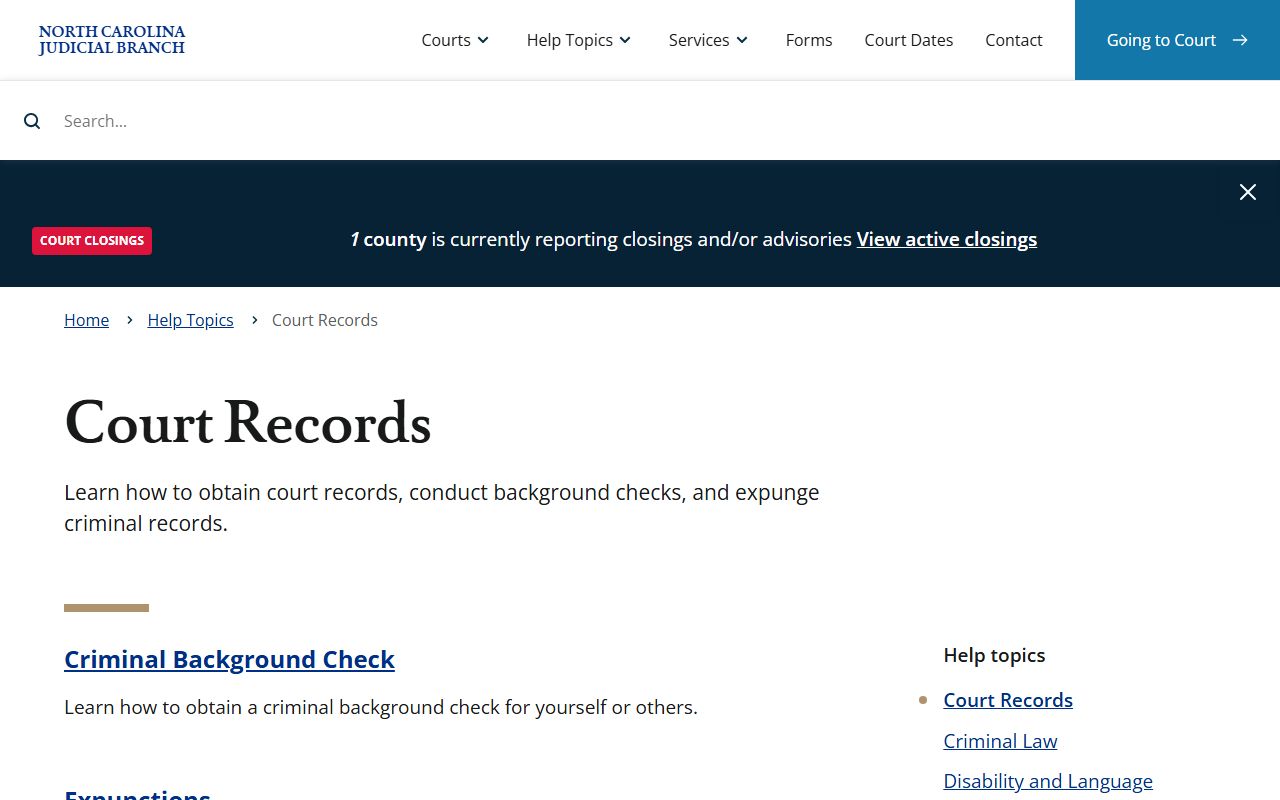
The help topic above is a useful starting point before you decide between an online search and an in-person clerk request.
Records That Are Restricted or Confidential
Not every Forsyth County court record is open. Juvenile court records are withheld from public inspection under G.S. 7B-3000, and they do not become public when the juvenile turns 18. Adoption records are confidential and sealed under G.S. 48-9-102. Expunged criminal matters are sealed or destroyed, though the AOC keeps a confidential file under G.S. 15A-151 for narrow uses. Mental health treatment information is protected under Chapter 122C.
Viewing a sealed record is not a routine request. A person usually needs a statutory access route or a court order. For an expunction, the petitioner must identify the right statute, file in the county of the charge, notify the required agencies, and obtain an order. Dismissed charges and not-guilty results follow G.S. 15A-146, while some convictions use G.S. 15A-145 or G.S. 15A-145.5. Because eligibility rules are technical, many people need legal advice.
Specialty Courts in Forsyth County
The Forsyth County Judicial Branch page links several recovery court models. Mental Health Court serves defendants whose court involvement is tied to mental health needs, using judicial monitoring, treatment planning, and compliance reviews. Adult Treatment Court, often called drug or recovery court, focuses on substance-use treatment with drug testing, frequent reviews, and a graduation process.
Veterans Treatment Court is also recognized as a model in the county's related-court list. These programs combine court supervision with veteran-specific services. Admission to any recovery court is not automatic. A person should confirm eligibility and referral steps with defense counsel, the District Attorney, or the clerk's office before assuming a case qualifies.
Forsyth County Sheriff and Jail
The Forsyth County Sheriff's Office is led by Sheriff Bobby F. Kimbrough, Jr. The county jail is the Law Enforcement Detention Center at 201 North Church Street. The official page describes it as an adult maximum-security facility of 400,000 square feet, an eleven-story twin tower with 735 modular steel cells and a bed capacity of 1,016 inmates. It houses both sentenced misdemeanants and pretrial inmates. On May 25, 2026, the public roster showed 975 people, close to listed capacity.
For the full roster and search fields, see Forsyth County inmate records. For active warrants and the sheriff's wanted lists, see warrant records. You can also track custody status through released inmate tools and notifications.
Marriage, Divorce, and Probate Records
Forsyth County splits these records between two offices. Marriage licenses and certified marriage copies come from the Register of Deeds, not the clerk. Divorce decrees are court records kept by the Clerk of Superior Court. Probate and estates also run through the clerk's estates division. For more, see marriage and divorce records and probate records.
- Testator
- The person who makes a will.
- Executor
- The person named in a will to settle the estate.
- Intestate
- A person who dies without a valid will.
- Guardian
- A person appointed to act for someone who cannot manage their own affairs.
Forsyth County Court Records Fees
Court costs in North Carolina are set by the General Assembly, and courts must collect them. The fees below come from official Forsyth and Judicial Branch sources. Court copy and search fees may follow the current statewide court cost chart, so confirm amounts with the clerk before you rely on them. Marriage and vital-record fees are charged by the Register of Deeds.
| Item | Amount |
|---|---|
| Marriage license | $60 |
| Marriage license plus certified copy | $70 |
| Certified vital record copy | $10 |
| Small claims filing | $96 |
| Sheriff service in small claims | $30 |
A view of the Judicial Branch court costs page shows where the official fee charts live, from the court costs help topic.
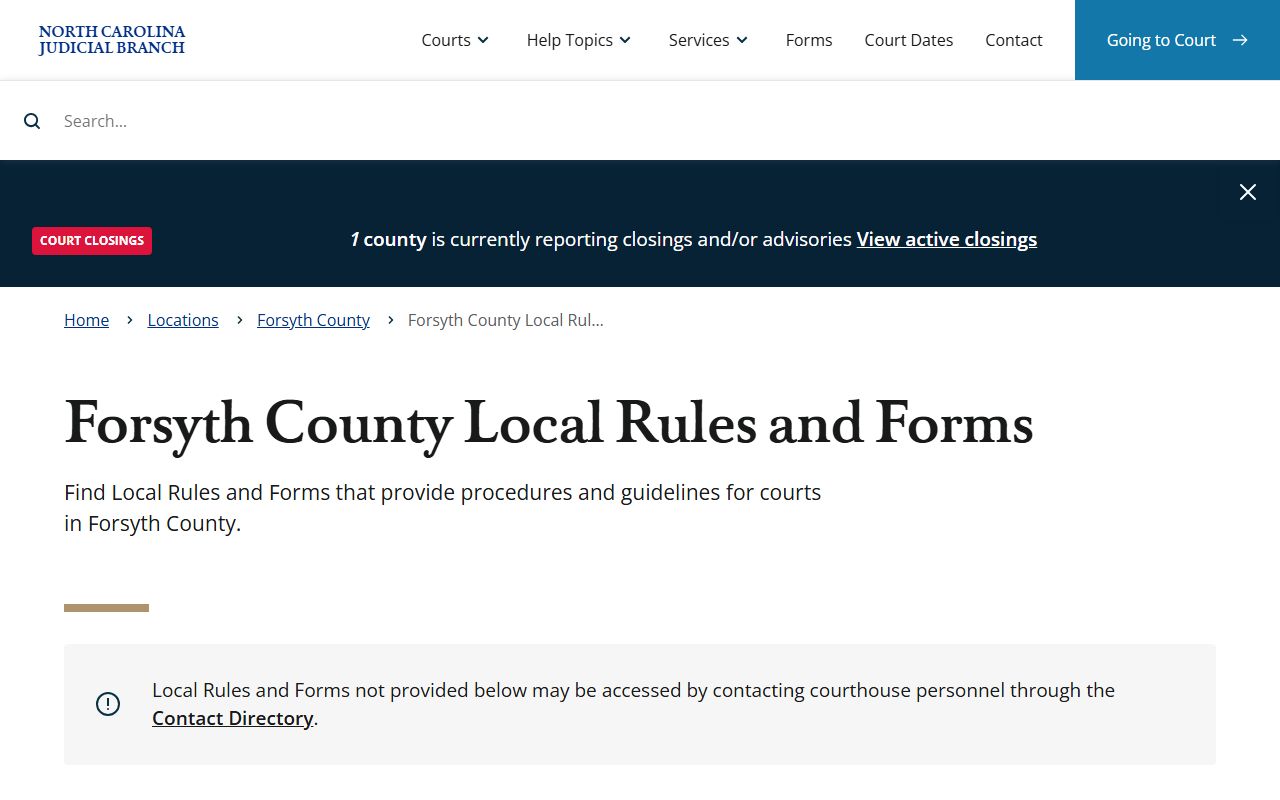
Local rules and forms for Forsyth County are posted by the Judicial Branch and are worth checking before any filing or payment.
How to Interpret Forsyth County Court Records
Court records use shorthand that can confuse a first-time reader. A charge is not a conviction. A disposition is the outcome of a charge or claim. "Dismissed with prejudice" means the matter generally cannot be refiled, while "dismissed without prejudice" leaves the door open. A continuance is just a postponement. The Register of Actions is the running list of everything filed in a case.
Criminal entries may show a plea, a verdict, a sentence, and probation terms. Civil entries may show a judgment amount and whether it was satisfied. When a record looks unclear, the safest move is to call the clerk and confirm before drawing a conclusion. An arrest or booking shown elsewhere does not prove guilt in court.
Accuracy and Record Limitations
The official portal training page calls Smart Search near real-time, but timing still varies. Sealed filings, document processing, and data conversion can all affect what appears. Older paper records may not be online at all and may need a direct clerk request. The public portal is not the official court record, so legal deadlines and certified copies should always be handled through the clerk.
Note: Always confirm case details with the Forsyth County Clerk of Superior Court before relying on online records for any legal, filing, or deadline purpose.
History of Forsyth County Courts
Forsyth County was formed in 1849. Record-keeping grew slowly over the next century. The Register of Deeds notes that some instruments date to 1849, but official recording did not begin until 1913. Early records were copied by hand, then typed, then microfilmed in 1954. Computerized indexes began in 1965.
The court system has changed fastest in recent years. North Carolina finished its eCourts rollout in all 100 counties on October 13, 2025, moving Forsyth from older terminals and legacy systems to the Odyssey-based portal, electronic filing, and online payment. That shift is the main reason most record searches now begin online.
Frequently Asked Questions
How do I search Forsyth County court records online?
Use the North Carolina eCourts Portal. Choose Smart Search for case records and Search Hearings for court dates. Search by case number when you have it, or by party name, business name, attorney name, citation number, bar number, cross-reference, or nickname. Open the advanced filters to narrow to Forsyth County, case type, status, and filing date range. The portal may ask anonymous users to clear a CAPTCHA check before showing results.
Is the eCourts Portal the official court record?
No. The Judicial Branch states that the public portal is not the official court record. It gives internet access to public docket entries for public case types. Official and certified copies must be requested from the Forsyth County Clerk of Superior Court. Use the portal to find the file number and parties, then ask the clerk for a certified document when you need one for legal use.
Where is the Forsyth County Courthouse?
The current courthouse is at 175 N. Chestnut Street, Winston-Salem, NC 27101. The main number is (336) 779-6300. Public hours run Monday through Friday, 8:00 AM to 5:00 PM, and the clerk's office is open 8:30 AM to 5:00 PM. The courthouse sits in downtown Winston-Salem, close to the jail and the Register of Deeds.
More on the Forsyth County Court Records FAQ page.