
North Carolina Public Records Act and Court Records
North Carolina runs two parallel access rules. The general open-records law is the Public Records Act in Chapter 132. It defines public records broadly and sets the right to inspect and copy them. The key section is G.S. 132-1, which treats documents made or received in public business by state and local agencies as public records. That covers most county-agency records in Forsyth County.
Court files are different. They are not governed by Chapter 132 in the same way. Court records have their own access statute, G.S. 7A-109, which directs the clerk to keep court records and, except as barred by law, keep them open during office hours. So a county budget or email is a Chapter 132 record, while a lawsuit or estate file is a 7A-109 court record. The two systems sit side by side. Knowing which one applies tells you where to ask and which rule controls the answer.
Anyone can ask. The Public Records Act does not make you state a reason or prove a need. A resident, a reporter, a business, or someone from out of state can all request a Forsyth County public record on the same footing. That open default is the core of the law, even though specific records can still be closed by other statutes.
A view of the statute that defines public records helps set the baseline, from the G.S. 132-1 page.
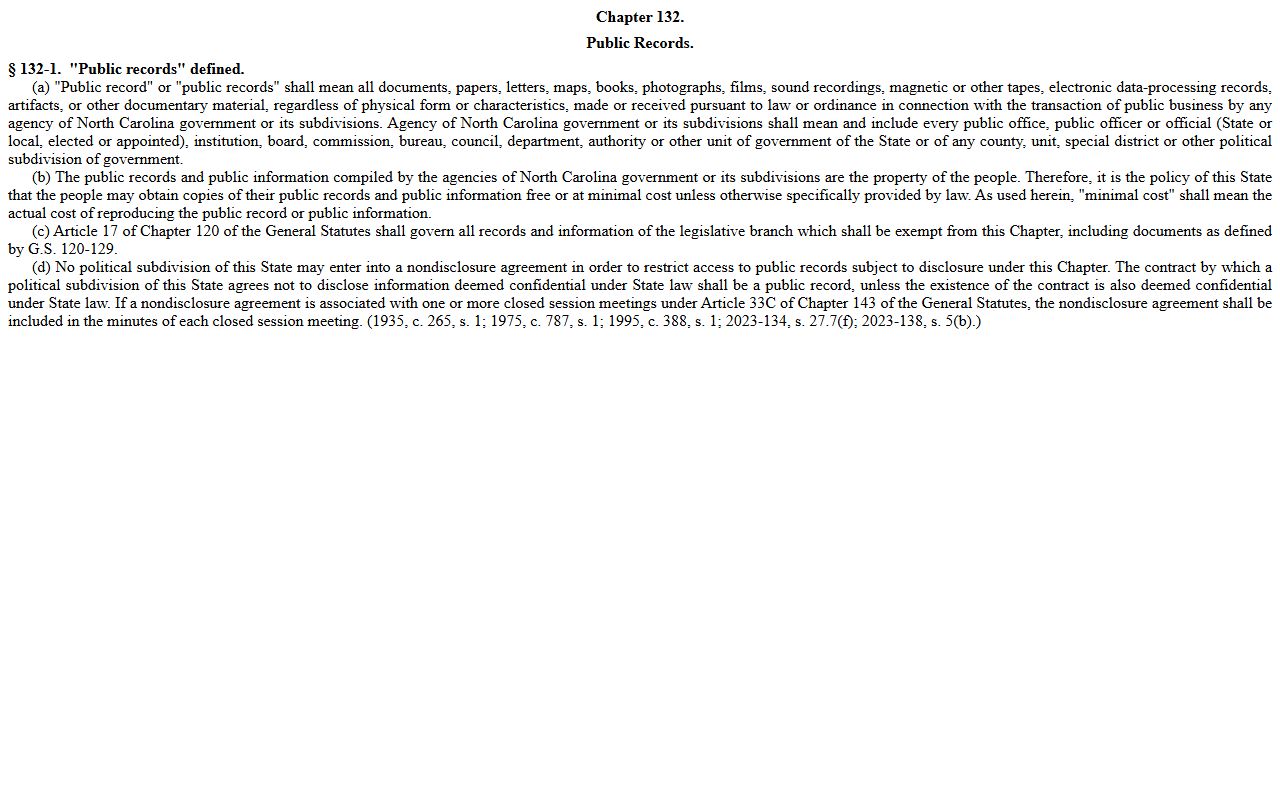
That section is the starting point for any agency-record request in the county.
Clerk of Court vs Register of Deeds in Forsyth County
Two offices hold most of the records people ask for, and they do not overlap. The Clerk of Superior Court keeps court files: civil suits, criminal cases, estates, special proceedings, judgments, and liens. The Register of Deeds keeps land records and the vital-record indexes for birth, death, and marriage. The Register of Deeds page is blunt about the line. It sends questions about Divorce Decrees, Estates, Foreclosures, Judgments, Liens, Wills, and Paternity to the clerk.
Access also differs by record type. Recorded land documents are imaged and searchable online at forsythdeeds.com. Vital records are different. The Register of Deeds keeps the birth, death, and marriage indexes, but those certificate images are not posted online and must be ordered from the office. Court files are searched through the statewide eCourts Portal, with certified copies coming from the clerk.
- Court files, estates, judgments, liens: Clerk of Superior Court.
- Deeds and recorded land documents: Register of Deeds, imaged online.
- Birth, death, marriage certificates: Register of Deeds, ordered from the office.
- County agency records, such as budgets and emails: the agency that holds them, under Chapter 132.
Note: military DD-214 discharge records are restricted under N.C.G.S. 47-113.2 and are not open to the general public.
How to File a Public Records Request in Forsyth County
The first move is to pick the right office. A request for an agency record goes to that agency. A court file request goes to the clerk. The Judicial Branch even runs a public-records request service, but it is for administrative records only; case files still go to the county clerk. Be specific about what you want and how you want it delivered.
- Identify the right custodian. Court files go to the Clerk of Superior Court; land and vital records go to the Register of Deeds; agency records go to the agency that made them.
- Describe the records clearly. Name the record type, the parties or subject, and a date range if you can.
- Submit the request. Use the office's mail, email, or online channel; for Judicial Branch administrative records, use the official request service.
- Wait for the response. Under Chapter 132 the custodian must allow inspection and copies at reasonable times.
- Pay any fees and receive the records. Fees are tied to actual cost unless a statute sets a specific fee.
The Judicial Branch request service explains what it does and does not cover on the request a public record page.
Public Records Request Form Fields
Whether you write a letter or use an online form, the same basic facts are needed. Give your contact details so the office can reply, then describe the record well enough that staff can find it. A clear request gets a faster answer.
| Field | Required | Notes |
|---|---|---|
| Requester Name and Contact | Yes for a reply | Name plus email, phone, or mailing address so the office can respond. |
| Description of Records | Yes | Identify an existing record; for court files, route to the county clerk. |
| County or Office | Helps routing | Names the correct unit, such as Clerk of Superior Court or Register of Deeds. |
| Date Range | No | Narrows the search and can lower the cost. |
| Delivery Preference | No | Electronic or other delivery may depend on the record. |
Response Timelines
North Carolina does not fix a single deadline in days. The law uses a standard instead. Under G.S. 132-6, a custodian must permit inspection and copying of public records at reasonable times and under reasonable supervision. "As promptly as possible" is the rule of thumb for agency records.
Court files work on courthouse access. The clerk keeps them open during regular office hours under G.S. 7A-109. Large or complex requests can take longer, since staff may need to gather and review files. A request that names a date range or a specific case moves faster than a broad one. If the office goes quiet, a polite follow-up that points to the statute usually helps. The clearer the request, the shorter the wait.
A view of the inspection statute shows the standard the law sets, from the G.S. 132-6 page.
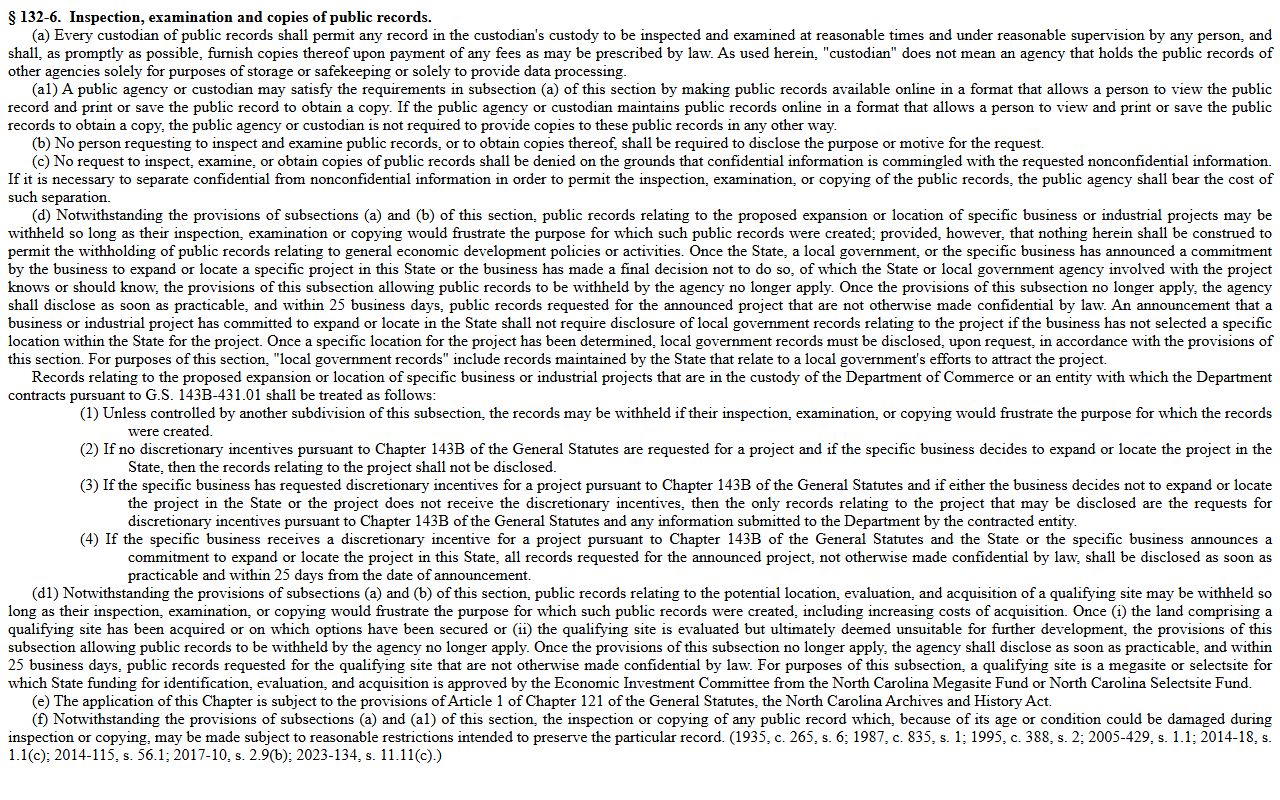
That section is the one to cite when an agency is slow to allow inspection.
Public Records Fees in Forsyth County
Fees for agency records are tied to actual cost. Under G.S. 132-6.2, charges generally track the real cost of making a copy unless another statute sets a fixed fee. A special service charge can apply only when the request takes extensive time on information technology or staff. Court copy fees follow the statewide court cost chart instead, so confirm those with the clerk.
| Item | Amount |
|---|---|
| Per page copy | Tied to actual cost under G.S. 132-6.2 |
| Special service charge | Allowed only for extensive IT or staff time |
| Certified court copy | Set by statewide court cost chart; confirm with the clerk |
| Certified vital record copy | $10 from the Register of Deeds |
The fee statute is posted in full on the G.S. 132-6.2 page.
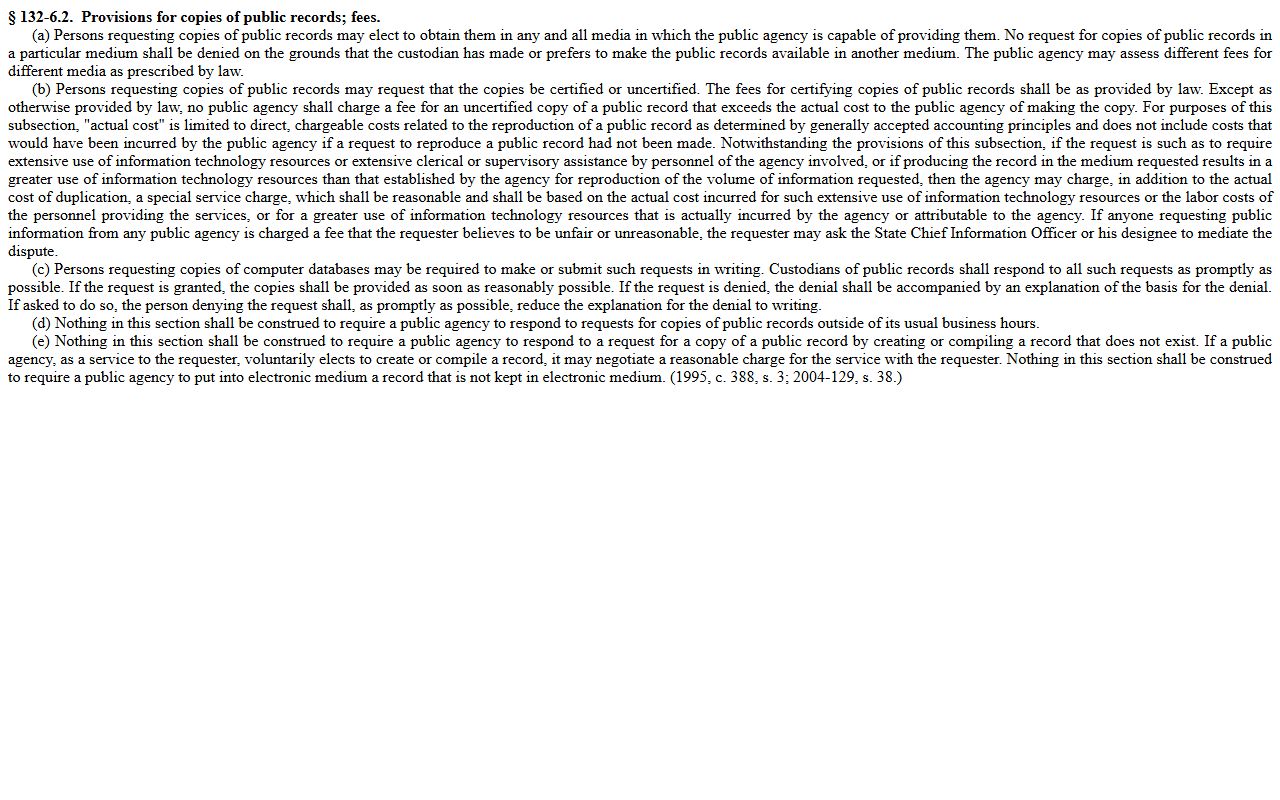
It is the basis for the rule that copy charges stay close to actual cost.
Records That Are Exempt
Not every record is open. Confidentiality statutes override the general access rule. Juvenile court records are withheld under G.S. 7B-3000. Adoption records are sealed under G.S. 48-9-102. Mental health treatment information is kept out of public records under Chapter 122C. Expunged criminal matters are sealed or destroyed, with only a narrow confidential file kept by the state.
Personal identifiers are also screened. Social Security numbers, financial account numbers, and driver's license numbers are redacted or left out. Sealed court filings, grand jury materials, and some domestic-violence safety details stay closed. These limits apply to both agency records and court files in Forsyth County.
An exemption does not always close a whole record. Often the custodian removes the protected part and releases the rest. So a request for a file with one sealed page may still get you the open pages. When an office withholds anything, it should point to the statute that allows it. If the basis is unclear, ask for it in writing before you decide what to do next.
If Your Request Is Denied
A denial is not the end of the road. North Carolina gives requesters a court remedy. Under G.S. 132-9, a person denied access may bring an action in court to compel disclosure, and the statute allows attorney fees under set conditions. That is the enforcement route for an agency that refuses a valid request.
Before going to court, it often helps to ask the office to state the legal basis for the denial in writing. Many disputes turn on whether a record is truly exempt or simply needs redaction. The denial remedy statute is posted on the G.S. 132-9 page.
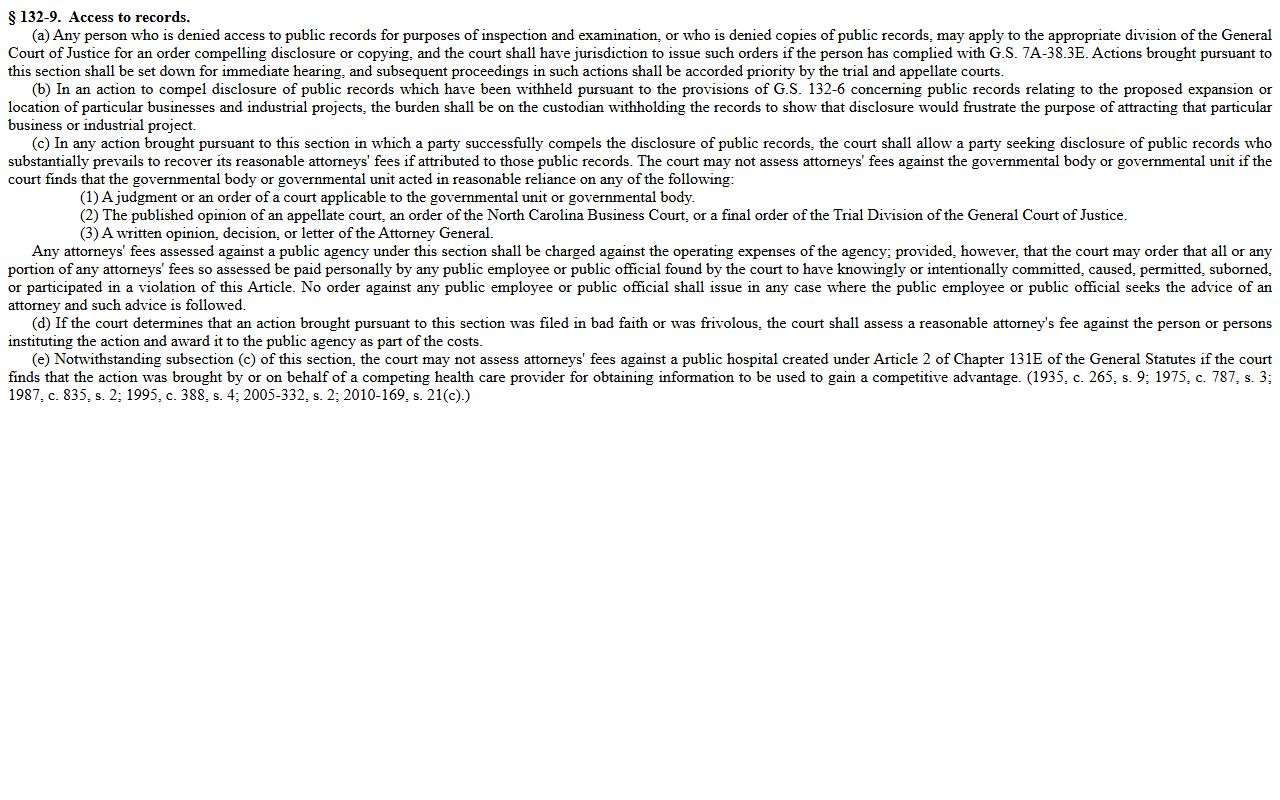
It sets out the court-review path when an agency will not release a public record.