
Forsyth County District Court Overview
North Carolina runs one unified court system called the General Court of Justice. There are no separate local court systems. Forsyth County cases are state cases heard in local sessions of the statewide system. The system has three parts: the Appellate Division, the Superior Court Division, and the District Court Division. District Court is the lower of the two trial divisions, and it carries the largest case volume. The official North Carolina District Court page describes its broad role.
Forsyth County sits in District Court District 31 and Superior Court District 31. The county is also Prosecutorial District 31. District Court here hears misdemeanors, infractions, traffic, family law, juvenile matters, domestic violence, child support, divorce, custody, and lower civil disputes. Small claims is part of District Court and is heard by magistrates without a jury.
One point matters a lot for searchers. North Carolina District Court is not a federal district court. The state District Court handles state trial matters in Forsyth County. Federal cases for the county go to the U.S. District Court for the Middle District of North Carolina, which is a separate system and not a source of county records.
Forsyth County Court Offices
The trial courts and their support offices all sit in the Forsyth County Courthouse at 175 N. Chestnut Street in Winston-Salem. Rather than numbered courts, North Carolina organizes the work by division and office. The table below lists the main county court offices, their roles, and direct phone lines, drawn from the official Forsyth County contact directory. Use the main line when no direct number is listed.
| Court / Office | Role | Address | Phone |
|---|---|---|---|
| Forsyth County Courthouse | Superior and District courthouse | 175 N. Chestnut Street, Winston-Salem, NC 27101 | (336) 779-6300 |
| Clerk of Superior Court | Record keeper, filings, estates/probate | 175 N. Chestnut Street, Winston-Salem, NC 27101 | (336) 779-6300 |
| Superior Court Judges | Superior Court sessions | 175 N. Chestnut Street, Winston-Salem, NC 27101 | (336) 779-6316 |
| District Court Judges | District Court sessions | 175 N. Chestnut Street, Winston-Salem, NC 27101 | (336) 779-6318 |
| Magistrates - Small Claims | Small claims and magistrate functions | 175 N. Chestnut Street, Winston-Salem, NC 27101 | (336) 779-6319 |
| Juvenile Court | Juvenile matters | 175 N. Chestnut Street, Winston-Salem, NC 27101 | (336) 779-6311 |
| District Attorney | Prosecutorial District 31 | 175 N. Chestnut Street, Winston-Salem, NC 27101 | (336) 779-6310 |
| Guardian ad Litem | Child advocacy in qualifying cases | 175 N. Chestnut Street, Winston-Salem, NC 27101 | (336) 779-6321 |
| Custody Mediation | Family/custody mediation | 175 N. Chestnut Street, Winston-Salem, NC 27101 | (336) 779-6613 |
| Court-Ordered Arbitration | Civil arbitration | 175 N. Chestnut Street, Winston-Salem, NC 27101 | (336) 779-6318 |
A view of the official court-structure page shows how these divisions fit the statewide system, from the structure of the courts page.
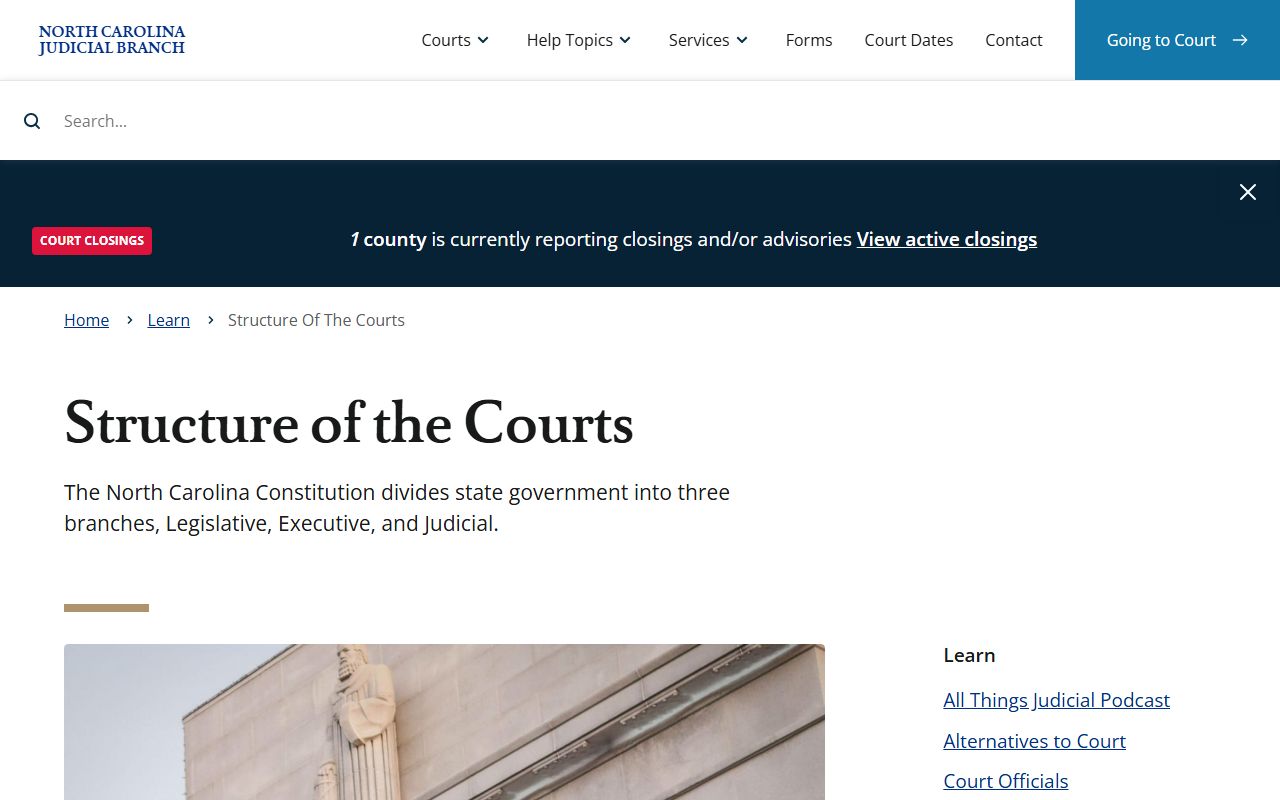
The page makes clear that Forsyth County District Court is one piece of a single statewide court system.
Superior Court vs District Court vs Small Claims
The two trial divisions split work by case type and severity, and small claims sits inside District Court. Superior Court is the higher division. District Court is the lower division. Small claims is a magistrate-run track for smaller money and property disputes. The comparison below shows the main differences for Forsyth County users.
| Superior Court | District Court | Small Claims | |
|---|---|---|---|
| Criminal Cases | Felonies | Misdemeanors, infractions, traffic | None |
| Civil Cases | Larger civil disputes | Lower civil matters | $10,000 or less |
| Family Cases | No | Yes - divorce, custody, support | No |
| Heard By | Superior Court judge | District Court judge | Magistrate |
| Jury | Yes | Sometimes | No jury |
A look at the official Superior Court page explains the higher division's role, from the North Carolina Superior Court page.
Superior Court also includes Business Court assignments for complex corporate cases when assigned by the Chief Justice.
How a Case Moves Through the System
A case follows a set path through the Forsyth County courts. The path depends on whether the matter is criminal, civil, or small claims. Knowing the flow helps you predict the next court date and the right record to pull. The diagrams below trace the common routes.
Criminal flow: Arrest › Magistrate / First Appearance › District Court (misdemeanor) or Indictment to Superior Court (felony) › Pretrial › Trial › Sentencing › Appeal
Civil flow: Complaint Filed › Answer › Discovery › Mediation or Arbitration › Trial › Judgment › Appeal
Small claims flow: Complaint Filed › Magistrate Hearing › Judgment › Appeal to District Court for trial before a judge
A view of the District Court page shows the kinds of matters that start in this division, from the North Carolina District Court page.
Most everyday matters in Forsyth County begin in District Court before any move to the higher division.
Family, Juvenile, and Criminal Divisions
District Court handles the family and juvenile work for Forsyth County. That includes divorce, custody, child support, equitable distribution, and domestic violence protective orders. District Court judges hear these matters, and custody mediation supports many family cases. Juvenile court handles delinquency and abuse, neglect, and dependency matters, with strong confidentiality rules under state law.
On the criminal side, District Court hears misdemeanors and infractions, while felonies move to Superior Court. The District Attorney for Prosecutorial District 31 prosecutes state cases for the county. Note: Custody mediation, Guardian ad Litem, and arbitration each have their own direct lines in the county directory.
Traffic and infraction cases also run through District Court. A traffic citation usually appears on a District Court calendar, with a court date, an offense, a statute, and a disposition once resolved. For ticket searches and payment options, see the county traffic court records page.
Domestic violence cases get special handling in District Court. A person can seek a protective order, and the county directory lists a Domestic Violence contact tied to the clerk. These files can hold sensitive details, so some information is redacted or sealed. Child support is another large District Court area, with its own division at the clerk's office. The court can set, change, or enforce support orders. Many family matters also pass through custody mediation before a judge hears them.
Small Claims and Magistrates
Small claims court is part of North Carolina District Court and is heard by magistrates, not judges. There is no jury. The official North Carolina Small Claims Court page says small claims cases include claims for $10,000 or less, recovery of personal property, summary ejectment or eviction, and certain motor-vehicle lien cases. In Forsyth County, the Magistrates - Small Claims office answers at (336) 779-6319.
Fees are modest. The state small claims filing fee is $96, and sheriff service is commonly $30. A small claims decision is not always final. A party can appeal a small claims judgment to District Court for a new trial before a judge. For more on the process, see the official small claims help topic.
A view of the small claims court page shows what magistrates can decide, from the North Carolina Small Claims Court page.
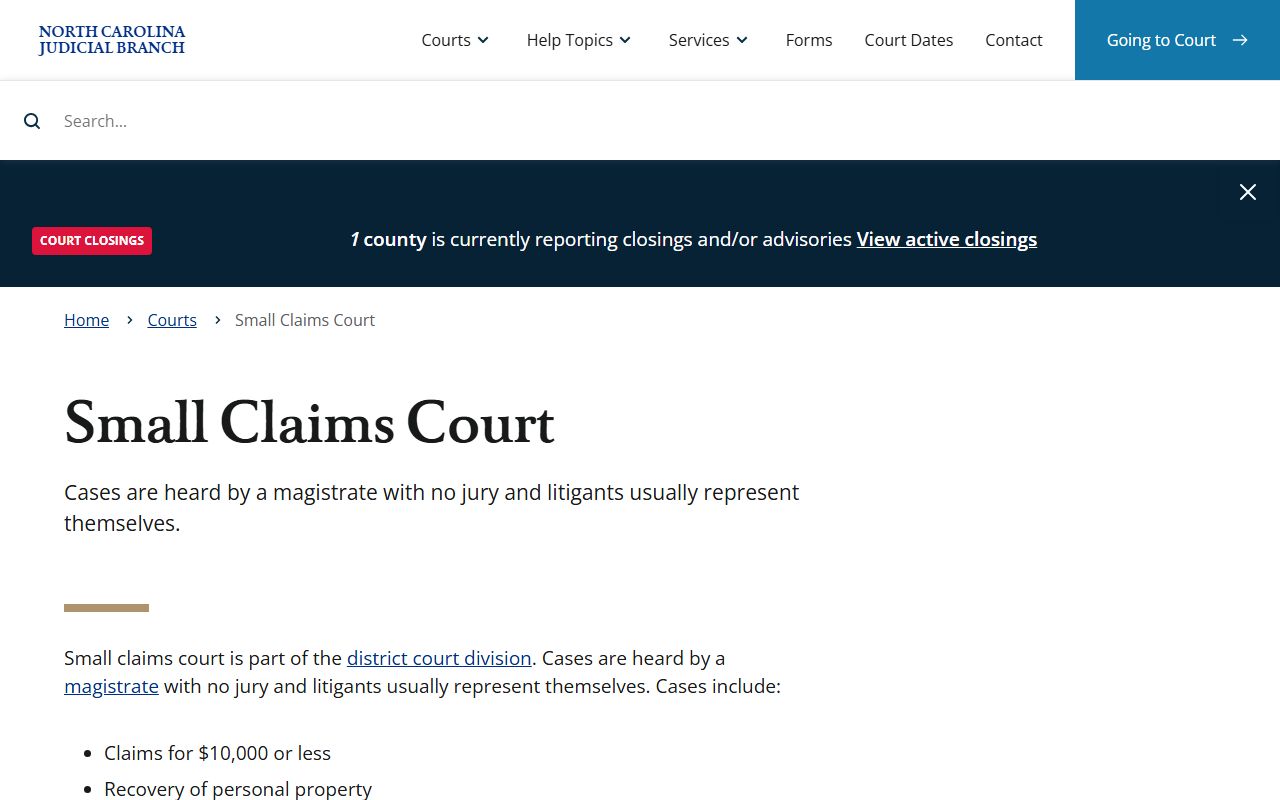
Small claims is the most common entry point for everyday money and eviction disputes in the county.
Appeals and Court Dates
Appeals follow a clear ladder in North Carolina. A small claims judgment can be appealed to District Court for a trial before a judge. A District Court misdemeanor or infraction can be appealed to Superior Court for a trial de novo, which means a fresh trial. Trial-court orders generally go up to the North Carolina Court of Appeals, and the Supreme Court of North Carolina is the highest state court.
For court dates, use Search Hearings in the statewide North Carolina eCourts Portal. You can search hearings by case number, party name, business name, attorney name, attorney bar number, judicial officer, or courtroom. The portal asks anonymous users to clear a CAPTCHA check every five minutes. Note: A small claims appeal must follow strict timing, so confirm deadlines with the clerk.
A view of the small claims help topic shows how appeals and filing work, from the lawsuits and small claims help page.
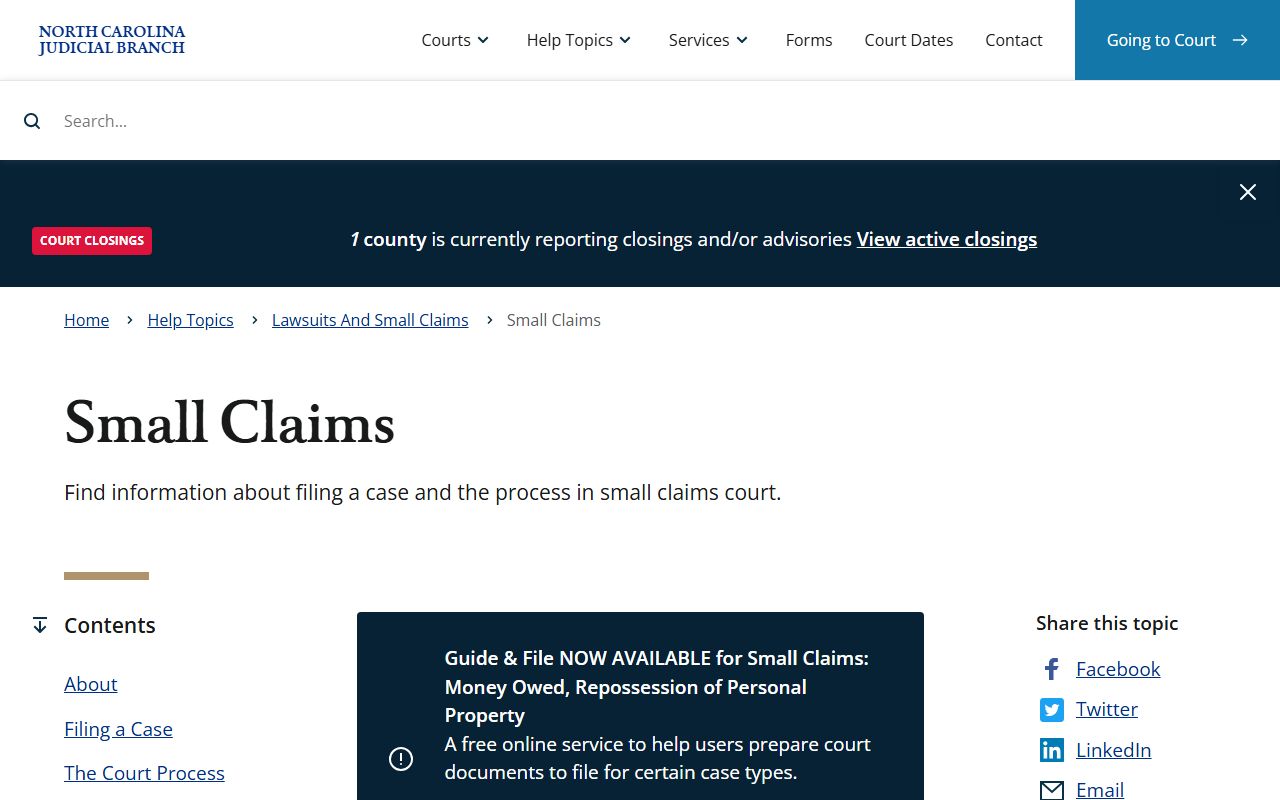
Knowing the appeal path keeps a Forsyth County case on track and prevents missed deadlines.
Local Rules in Forsyth County
Beyond statewide rules, Forsyth County has its own local rules and forms. These cover items like calendaring, family court practice, and an administrative order on cell phones and electronic devices in the courthouse. Review the current order before bringing a device into court. The official Forsyth County local rules and forms page posts these documents.
The county landing page also links court dates, forms, and related programs. Start there for general District Court questions, from the Forsyth County Judicial Branch page.